Pages

Wednesday, December 31, 2014

Switch: How to Change Things When Change Is Hard by Chip Heath

Switch: How to Change Things When Change Is HardSwitch: How to Change Things When Change Is Hard by Chip Heath
My rating: 3 of 5 stars


So this is not a bad book, but has the misfortune of a competing title that addresses the same issues in more depth and with a more specific framework in roughly the same amount of space. I do like that it talks about change as a simple 3 step process, but Influencer just gives a better tool set. I don't know offhand which one was published first, but they share several of the same examples. Perhaps some borrowing is going on, but that is not material to me since I am focusing on my personal usefulness of the material. If you want to read a book on change, read Influencer. If you've already read Influencer and want a different vantage point on essentially the same principles, then Switch is the book for you.

If I were to call out a nugget of wisdom from this book, there is a useful sections that comes to mind. I really liked the part about action triggers. Just making the decision, setting goals, and structuring the environment doesn't guarantee success in your change effort. Adding some other features to the effort will increase your likelihood of success, and one of those is attaching required activity to outside triggers. An example is attaching a planned action--such as homework--to a specific date, time and place in relationship to an unavoidable event, such as Christmas morning.

Finally, this book does break with my common observation about business books being one third too long, with the last section of business books usually feeling like useless filler to hit a page target. This book gives great tips, examples and applications of the content at the end of the book. A small thing, but nice. Unfortunately, I think the first part of the book could have moved faster, but you can't have it all.

Monday, December 1, 2014

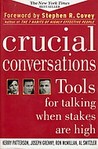
Crucial Conversations: Tools for Talking When Stakes are High by Kerry Patterson

Crucial Conversations: Tools for Talking When Stakes are HighCrucial Conversations: Tools for Talking When Stakes are High by Kerry Patterson
My rating: 4 of 5 stars

This review is a little ironic because I have championed the content from this book for years. I first encountered it around 2006, and have shared some of its key messages with others ever since. I have even added it to our annual list of books we study together at work (along with Five Dysfunctions of a Team and Leadership and Self Deception.) So why am I reviewing it now? Well, it is because every other time I have been distracted and not finished it, or have just reviewed sections rather than read them word for word. This time, with an upcoming training session I was conducting on my schedule, I made sure to read every word, and finally add it to my "Read" list.

So the content in Crucial Conversations is transformative. The power is not in the idea that some conversations are difficult or crucial, or even that we generally handle them poorly. The value is in the clear description of the model for how to handle crucial conversations. It is still difficult, but I have told new stories to myself and supported continued dialogue in many situations. My results with the content have made me a firm believer that this book is a must read for anyone who wants to improve the quality of communication with those around them.

So why didn't I give 5 stars if I'm such a fan? Well, I believe that I got a lot of value from this book in part due to other content I have come in contact with. Five Dysfunctions of a Team, Getting Past No, and others have provided many frameworks and situations that leverage the crucial conversations skills. With a 4-star rating I'm admitting that there are some situational applications that aren't covered by this book. Add those other titles to your reading list, and you'll get 5 stars worth of value out of this one for yourself.

Sunday, November 30, 2014

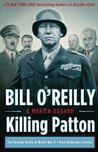
Killing Patton: The Strange Death of World War II's Most Audacious General by Bill O'Reilly

Killing Patton: The Strange Death of World War II's Most Audacious GeneralKilling Patton: The Strange Death of World War II's Most Audacious General by Bill O'Reilly
My rating: 3 of 5 stars

This book asserts that General George Patton, who died after being in a car accident, was actually murdered in a plot hatched by a combination of American and Russian spies. While the book does raise some questions, there wasn't enough here to convince me. However, the plot went on many small side trips through the events of World War II. These were both informative and sickening. To hear what men did to other human beings is a reminder that good and evil, right and wrong, do exist, something that somehow is not politically correct to say anymore.

So this may seem random or unrelated, but I'm going to share a business lesson I learned from this book. Patton was not a great manager. He may have been a good leader, and was obviously a gifted strategist, but when it comes to managerial effectiveness, I don't think it was his thing. My key takeaway is that it didn't matter. As a country we needed him for his strengths, and so we had to take the weaknesses too, and that was the right decision. Unfortunately the army, like life, gave him responsibilities in both his weak and strong areas. I'll give a brief example, and then an application.

On several occasions Patton assaulted men suffering from depression who couldn't fight anymore, called them cowards and in one case threatened to shoot the soldier. He was drawing his sidearm when the medical staff restrained him. Those scenes were not in the heat of battle, but in hospitals, and were driven by emotions that arose because of who he was. He felt that mental instability was really just cowardice. But no matter what happened, the Army, and the country, needed him so badly that we essentially had to put up with it.

This is easy for me to apply. Regularly I have the situation where an employee has a specific trait or skill set that I need, and in every case it is hard to deal with his/her weaknesses. It almost seems to correlate. The more specific expertise I need, the more baggage comes with the person who has the solution. I have thought in the past that this is something that I struggle with uniquely, but I realized that it is common. Then I consider how often I might have been that guy with weaknesses that my manager has to put up with. That is a sobering thought, to put yourself in those shoes. We are all imperfect people trying to win wars in spite of weaknesses, both those in others and our own.